Showing posts with label productivity. Show all posts

Monday, 1 February 2016

Self-Talk: How to manage emotions, think rationally, and repair situations

Allow me to set the scene by describing a situation that I found myself in a while ago that got me thinking about the way that I think. I was working in a high-paced environment in charge of a very stressed-out group of workers, when my project manager pulled me into his office for a private meeting. He told me that the project was under scrutiny from the client and that my department (the administration group, who already got jerked around quite a bit) would be moved from site to our head office resulting in major pay cuts to our team. I noticed my heart beat speed up, my mind start to search for answers, and my tone get defensive quick. I started arguing with my boss on my team’s behalf, and after a few minutes I had to leave his office before I really lost my cool. I went back to my office, slumped down in my chair, and immediately regretted my initial response.

As I stewed at my desk, I realized that the problem really wasn’t that big, and several solutions existed that would likely result in positive outcomes… so why was I so blind to this before? My initial emotional response interrupted my logical thought process and made the problem substantially harder to deal with. This initial response was also damaging to my relationship with my project manager, and ultimately did not help the situation at all. I found myself pining over different situations where I had similarly reacted solely on emotions, and began brainstorming actions I could take in the future to avoid such outbursts. My learning journey brought me to a concept called “self-talk”.

"Self-talk” is the process of creating inner dialogs with yourself to rationally and productively deal with situations that initially result in an emotional response. Self-talk is an amazing tool that has helped me manage my emotions in situations where logic is necessary but absent. It has also helped me stay cool and level-headed in stressful situations, and has given me insight into issues in a way that before seemed impossible.

You're probably asking yourself: how can I actively engage in self-talk when I feel emotions take the wheel during important discussions and debates? Thinking logically can be especially hard in the heat of the moment, so how can I kick-start the process? Engaging in self-talk isn’t the same for everyone, and different techniques may work better for you, but here are five tools that I use when I need to jolt my brain for logical thought.


It may seem obvious reading this, but is much harder to do in the moment: the best thing you can do when you find yourself feeling frustrated and emotionally charged is to separate yourself from the stressor. When a difficult situation arises and challenges your self-esteem your subconscious mind begins processing and dissecting the situation before your conscious mind has a chance to fully grasp what is happening. Your body's flight or fight response engages and your emotions take the drivers seat, often leading to bigger problems down the road. 

Point blank: you will not resolve the issue leaning on emotion alone, and your mind needs time to absorb and adjust to the situation. Take a walk, sit with your eyes closed, go for a drive, or meditate. 

I'll be the first to admit, there are a few holes in this first step. Sometimes you can't escape the person that is causing you stress. If you are in a meeting with your boss, telling him you need a minute alone might bode poorly, or if you're in the car with your partner, I don't recommend "ducking and rolling" to escape (although, the physical pain might make the emotional pain seem trivial). What I'm getting at, is that there will be times you cannot escape your stressor, in which case it is important to notice when emotional reactions set in and pay attention to how your subconscious mind reacts. If you cannot physically escape, take a brief moment to compose your thoughts, and try the next steps in this process internally. 


I'm sure a philosopher said it using beautiful metaphors, but I am not that, so I will say it in laymen terms: a healthy body fosters a healthy mind. When a stressor catches you off guard your body often reacts faster then your mind and it begins triggering different flight or fight responses before you've even had a chance to absorb the information you are receiving. Have you noticed a tingle down your back when you're told something negative? A weakness in the legs? A restlessness? Maybe your hands get cold and your heart rate speeds up? These physical reactions, in collaboration with your emotions, are your body's natural defense mechanisms at work, doing what they are designed to do: protect you from harm by removing logical thought from your "to do" list. The problem is the physical reaction was triggered by something that has no actual threat to your physical safety, and these reactions can actually hinder your ability to deal with highly stressful situations. 

When I notice my body reacting to a situation before my mind has had a chance to process, I try to do 3 things which help return my body to homeostasis so my brain can start thinking about the problem rationally: straighten my back, stand up tall, and ground myself by standing with my legs shoulder-width apart. This process may seem trivial, but doing such things will contradict your body’s natural response, and will help you avoid a spiral of emotion led by your subconscious.


Breathing is one of those automated human functions that we rarely think about, but has a huge impact on the way we react. Controlling your breathing is a simple activity, but it has a huge impact on your body's reaction to a situation, which directly influences your initial emotional response. 

My favourite breathing exercise is called the Belly Breathing Technique. Start by placing one hand on your stomach directly above your belt line and the other hand on your chest. Start by exhaling deeply, focusing on relaxing your shoulders and upper body. Close your mouth and breath in deep through your nose, focusing on your rising chest and filling lungs. Stop and hold the air in. Exhale slowly,  through your nose again, as long as feels comfortable. Repeat. 


This next step is designed to help you start engaging in productive self-talk. In order to constructively deal with your stressor it is important that you find a way to distance yourself from the initial event and look at it in a clinical and emotionally detached way. A great way to change your perception on the stressor is to simply write down every detail you can remember about the initial event. Write down the words that were said to you, what you said to the other person, comment on the tone of voice, the body language, the wording used, the speed of the conversations, how you felt at the time, how you think the other person felt at the time, and anything else that had an impact. Most importantly, try to determine the specific emotions you were feeling in the moment and what you are feeling as you write.

Active self-talk takes conscious effort and thought, and a headspace absent of the emotions felt at first offence. Detailing the situation (almost like a crime scene) will allow you to look at all the facts outside of your personal lens. This clarity may enlighten you as to why the situation played out the way it did, and may alter your reaction to what is happening. Additionally, identifying your emotions can help you run them through your logical thought process, and help  to reduce the level of emotion you feel.


In the moments following a tense interaction, your mind may be swimming with thoughts that are being influenced heavily by your emotions, but often if you think about the stressor in a logical way you can thwart your initial emotional response. In addition to the above tools, asking yourself guided questions can help trigger logical thought and put the situation into perspective.

  •  Was all relevant information communicated, and is everyone on the same page? 
    • Make sure that all parties have all the facts, so that at the very least, everything is transparent and open. Keeping your thoughts on the matter secret can hinder your ability to recover and could cause problems going forward. If the information wasn't properly communicated during the initial interaction it can be useful to calmly and rationally explain yourself at a future time, once the dust has settled. 
  • What emotions ran through my head during the interaction? Are these emotions impacting my response?
    • Being aware of your emotions and how they manifest in your body is a big part of understanding yourself. This process can be challenging as people inherently feel things, but do not often justify these feelings with descriptors. Saying to yourself "I am feeling X (EMOTION eg. anger, fear, sadness, etc.) right now, and it is manifesting itself as Y (PHYSICAL RESPONSE eg. butterflies in tummy, fast heart, sinking feeling, etc.)" is a powerful way to understand yourself and work through the emotions that are blocking your logical thought process. 
  • What was the other person's likely thought process in the situation? What emotions are they feeling? 
    • Putting yourself in someone else's shoes can help you understand the reason for their actions during a tense situation. Think about what they must be feeling towards you, what is going on in other areas of their lives, and their experiences that have led to this moment. When we are upset it can be easy to forget that other people are equally as complex as us, with diverse thoughts, feelings, and emotions which are intermingling with your own. Respect this, and understand it as you process the situation. 
  • Are the results I am feeling going to have a lasting impact, or are they temporary? 
    • How serious is this? Really. In the heat of the moment, uncomfortable situations can seem as though they are earth shattering, but often times they pass quickly, and the status quo returns again. Is this situation going to matter tomorrow? Next week? Next year? Most of the time, these things blow over quickly, and reminding yourself of that can help keep the severity in perspective. 
  • Does this situation impact my entire life, or just a small portion?
    • Again, in the heat of the moment a bad interaction can feel as though it will bleed into all parts of your life, which often is not the case. If the problem arose at work, likely you can escape it at the end of the day, and find comfort and support in your home life. It can feel as though a negative experience will devastate your entire life, but typically that is not the case. 
  • What advice would I give a friend who brought this situation to me?
    • Often times, we judge ourselves harder than our peers because we feel as though we are somehow different than those around us. We often look at situations in a light that paints us as the problem or victim in a situation, which is often not the case. If a friend you respect brought you the situation which is causing you stress, and asked for your advice, what would you say? Chances are you can see things a bit more clear when you aren't the one directly involved. 

Monday, 9 November 2015

One Simple Tool to Declutter Your Mind

I'm a huge scatterbrain.

I tend to have 100 things on the go and walk a fine line between getting a lot of stuff done and spreading myself too thin.

It's easy to feel overwhelmed when you have multiple projects with many people and variables involved.  

Sound familiar? 

Then it's time to get organized and get some of this work done! Something I've used for years to get my thoughts in order are mind maps

I know some of you might be hesitant to use these, but if what you're doing isn't working it's time to try something new. If you are a visual or abstract thinker, mind maps can be very helpful for organizing your thoughts.

I've used mind maps for years and coached others in using them to plan and focus. Here's a simple run down of how mine work:

1. Open up a blank page in a workbook or unroll some poster-board and jot down what you want to benefit from your planning in the center of the page. (For example: "My life", "My business", "School" etc...). We will call this your Primary Category


2. Next,  write down what you might call subgroups of the Primary Category you've written down. The things that make up that category (For example, if you wrote down "My Life" you might put down some of the things that you're currently working on or want to focus on going on in your life, such as work, diet, school etc...). Try to break it down into anything that seems important related to your first category. We will call these Secondary Categories.


3. From here, you want to further break down the Secondary Categories. For your mind map to be worthwhile to you, you will usually have to go at least this far. If your next steps haven't become clear, you have to keep going. If you've tried making a mind map before and stopped here, that is probably why it wasn't effective. If you still feel lost you need to keep breaking these categories down. 

It takes at least three levels of breaking down to get past the superficial thoughts that we tend to get hung up on. At the third level of breaking down categories, we start to see some new things. We might notice that it can become a little bit harder to think of what our secondary categories were made up of. At this point, the way you break down the Secondary Categories might become more abstract. This is okay, your mind map isn't for anybody else: it's for you, and what matters is that you understand it. 

It's usually our basic level of understanding of what we're doing and why we're doing it that makes it seem overwhelming. Mind mapping forces us to break down what we are doing and why we're doing it enough that we better understand not only what we need to do to accomplish what we must, but also so that we can assess, prioritize, and evaluate what we're working on or what we want.  

For example: 


It starts to look a little bit more complicated right? 

As you can see in the diagram above, the sub-categories beyond the Secondary Categories take on a bit of a different form depending on what the Secondary Categories mean to you and what you value or want to accomplish. 

I put vegetables under diet because, despite being an adult, I don't eat enough broccoli. 

That's a simple example because it's already at the level of being a specific goal. From there I might simply want to jot down a note on how I will accomplish that goal.

Example:

Diet -> Vegetables -> Make meals at home once a day (make it realistic for you)

 You don't want to waste too much time on the things that are already fairly clear to you, those aren't the reason why you're stressed or lost. It's the more complex things that require a deeper level of understanding, You'll notice at this stage that some of the subgroups are still categorical while some feel more like specific goals. In the example, "Marathon" may already be at the level of a specific goal to your understanding, whereas "Project 1" for "Work" may still be a looming, not well understood monster full of confusing variables and a variety of tasks. 

4. The less specific subcategories here need to be broken down further. As we were saying, if "Project 1" still seems daunting, it has to be broken down into tasks, goals and outcomes so that it can become manageable. Here is an example of what that could potentially look like:


As you can see, things start become much more clear and manageable by this point. This is where you might have an A-ha moment and can then go on to realize that some things can be delegated, maybe aren't necessary, and make some specific to-do lists. Once you've broken everything down to the level of some specific tasks or desired outcomes, you can use a highlighter or make a list to help prioritize these items and best use your time in the most productive way. Continue to break down the items until they are at an understandable and specific level. Put this up on your wall and review it or re do it until you are where you need to be. Check things off as you accomplish them. 

 You can apply this method to almost anything. Listing the pros and cons of a decision, planning a big project, mapping out your goals with your spouse and how you want to accomplish them, group projects... the list goes on. Mind maps can be a very useful tool, especially if you tend to be more of a 'visionary' or big picture type of thinker and it takes more effort for you to drill in on specifics to make your big dreams a reality. 


Monday, 26 October 2015

3 Ways to Motivate Your Team

If you've just started leading a team of people, it can be a steep learning curve. Especially if you're stepping into an established organizational culture.  
Is your team engaged, or just present? Do they seem to care about what they're doing? 

Having a disengaged team will at best make your organization stagnant and at worst hurt you and your organization beyond belief. Having a highly motivated team will help your organization reach levels of success and productivity that you may not have thought possible. If you're struggling with this you already know first hand. If you've been on a winning team you might be able to identify how good leadership can contribute immensely to motivation. Let's articulate some of those things that good leaders use to motivate and break them down into actions we can take. 

Here's three key concepts that changed how I think about leadership and that I've used to better motivate my teams: 

1) Be Curious and Care

Be curious about your team. Care about your team. Care about your work. Care about your organization. 

Leadership roles typically come with a degree of control and a power dynamic attached to them. Used intelligently, this puts you in the driver's seat for motivating your team. 
First, remember the obvious. Beyond whatever your roles are in relation to each other in your organization, you're a human being and they are too. This is important because it's at the heart of motivation. Understanding what your employees care about, what matters to them, what they want and need, gives you insight into how to get them engaged.

Think about it. What motivates you? Think about places you've worked or volunteered. What made it a good or a bad place to work? You'll probably think of the manager or other leader. Things they did or didn't do. How you either felt appreciated and like what you did mattered, or like it was a waste of time and energy. You either felt valuable, or like you were treated as just another number. 
Remember this feeling. Let it guide how you communicate with your team. 

You know how it feels to have a leader who just can't engage or doesn't make the effort to. You know how demotivating this is. Do not be that person. 

Pay attention to what your team is saying. Value their input. Listen. Find out about what's going on with them. You don't have to be friends, but you need to have a mutual understanding and respect if you're going to motivate them. 

Remember that you only exist as a leader in relation to your team. You aren't doing this alone. Your mission is to lift them to new heights, to inspire, you're part of the team not something separate from it. 

To do this you will have to make time for it. Make time to talk to your team. One on one and in groups. Some things will come out and become apparent to you in the group, others will only come out in one on ones.

Yes this can be hard or seem like a lot of work. Understand that the biggest challenge is overcoming your own mental conditioning. It isn't as hard as it seems and is a skill you can develop, you'll become more comfortable with practice. It takes time, but it is definitely worth it. Building relationships with your team where they feel like you care will keep them going when they're having an off day.  

Remember that your team members are the heroes in their own stories, not you. In their eyes, your job is to empower them. You're just helping them get to where they want to be.  


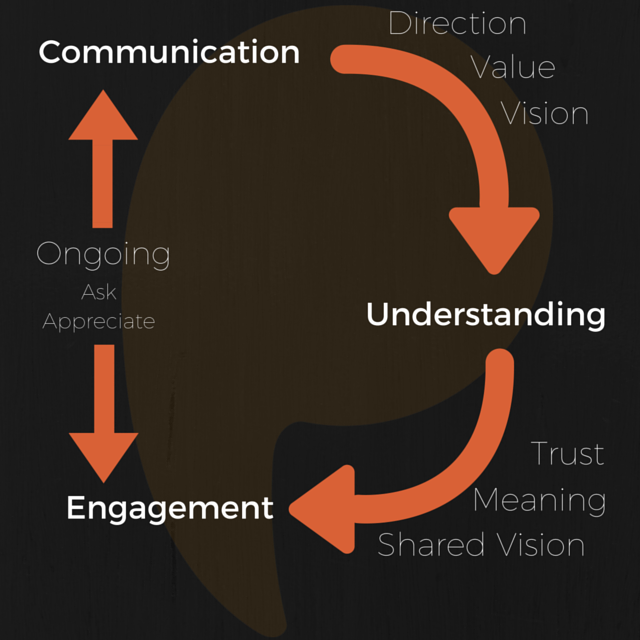
Are you leading in a curious and caring way? Use the inner dialogue of considering the three A's as you go about interacting and making decisions:


Ask - Ask questions, stay curious, ask yourself questions, reflect on changes in behavior and ask questions about them.  

Appreciate - Appreciate responses, appreciate actions, appreciate outputs and outcomes, celebrate your team, recognize your team, value your team's accomplishments, encourage and push forward.

Action - After asking questions and gathering information, evaluating and understanding circumstances and situations, take action.     


2) Communicate Constantly


One of the biggest mistakes that a leader can make is not communicating clear expectations. If people don't know what they should be doing, you really can't fault them for their disengagement. As leaders, we fail by not setting up a foundation for everyone's success. You may have a vision, but people can't buy into it if it isn't communicated or understood. 
If they don't know what to do, provide direction. 
If they know what to do, do they have everything (tools, resources, support) they need to do it properly? 

Ask yourself these questions and ask your team these questions.


Use the three A's constantly. 

Ask, Appreciate, and take Action.  

As a leader, it is your responsibility to make space for the conversations that need to happen. Whether it is regular team meetings or one on ones, you have to create that space. You have to make the time for it and organize it. 

When you have that space, that is your opportunity to work towards the changes you need. Often, your team is looking to you for guidance and about what to do to be valued and appreciated. These are huge intrinsic motivators for people. You set the stage for what behaviors are valued in the organization, and it really does come from you and your communication (or lack of communication) with them.    

This is your team. You need these people and they need you. Show appreciation for the things that they do, treat them as the competent and valuable people that they truly are. It takes time to build up a culture of trust and respect, if you do this very deliberately from the beginning with new recruits it will make it all the easier. 

3) Collaborate and Coach


Empower your team and support them. Give them the tools that they need to do what is expected of them. 

No, not every decision needs to be made by committee, but your team will be engaged when they feel a sense of ownership over what they're doing.  As a leader, you're a coach guiding your team to succeed at achieving the shared vision. You establish and cultivate that shared vision and then make and implement the plan with the team. 

Everything is about them and their success, amplified through the organization, facilitated by you. When you know what they want and need, you can work with them to bring out their strengths for incredible results. You have to ensure they see the value of being part of the team, of the organization and it's values, and of themselves. 

Deal with problems through discussion. Be assertive and use data and documented information to back up what you're saying. Remember, this is a human being who is going through something too. Never make a personal attack. Your mission is the success of the organization and that depends on the success of the team behind it. A team that depends on each of it's valuable people. Get to the bottom of it, ask the right questions, understand the problem, then make decisions about it.  


Kick Stress Today. 5 Real Tips You Can Try Right Now.

If you've never been stressed and don't get what the big deal is, turn off your laptop, put your head down on your desk or the magical (presumably soft, cotton-y) cloud that you're living on, close your beautiful eyes on your wrinkle free, remarkably soft face, and go back to sleep. 

For everyone else who goes through stress on a semi-regular or regular basis, come on in.

I had to write about stress today because it can be a massive productivity killer. 
If you've experienced this, you know exactly what I'm talking about: you feel so overwhelmed that you opt to do nothing rather than deal with the list of things you have on your plate.

First, take a deep breath. You're not alone. 

Stress is one of the most widespread and debilitating problems that many of us deal with on a daily basis. In a sense, stress is a really mean and imposing pirate that is hijacking your body against all of your rational sensibilities. 

When you're under a lot of stress, you'll find it tough to think about anything other than the stressor, and your non-essential bodily functions are thrown aside as your body goes into "fight or flight" mode. Your immune system's down (uh oh you're getting sick), your reproductive system's down (sorry honey), and your digestive and growth systems aren't working so well.

Let me just pause for a second here and apologize for stressing you out by describing stress. 
It's important to understand what's going on in our bodies and why dealing with stress in healthy ways matters.

Bare with me...  

The other problem with this stress is... you probably don't have to fight or run away from anything. Your life is most likely not being threatened at the moment (hopefully) and you also probably can't run away from whatever it is that your mind would prefer to avoid.
This is absolutely key to beating the stress you're feeling. 

Read it again. 

Say it to yourself:
"I'm not currently running for my life from a predator who is trying to eat me.
I'm not currently running for my life from a predator who is trying to eat me.
I'm not currently running for my life from a predator who is trying to eat me."


If you are, call the police and stop reading until you are in a safe place.  

I'm making a big deal about this because it's how you're going to start take the steps to beat your stress. Something important to do not just for the immediate benefits to your ability to get things done, but for your long term health and the people around you who are putting up with your stressed out ass everyday. 


According to Robert Sapolsky (Titan of stress research & Professor of Neurology and Neurological Sciences at Stanford, all around intellectual bad-ass), "If you plan to get stressed like a normal mammal, you had better turn on the stress response or else you're dead. But if you get chronically, psychosocially stressed, like a Westernized human, then you are more at risk for heart disease and some of the other leading causes of death in Westernized life." (from here)


Makes sense though right? If you've been under extreme stress you may have felt like leaving entirely or throwing your phone off of a bridge (Spoiler alert: if your stress is this bad, it might not be a completely terrible idea to lose your work phone). You may have gotten sick, said something you regret to someone you care about, not gone to work or class, etc... 

The point is, you aren't totally screwed. Even if you have been experiencing chronic stress for a long time. Even if you have deeply embedded trauma from your childhood and stress has been a feature of your life as long as you've known. You aren't screwed. 

Sapolsky goes on "We are capable of social supports that no other primate can even dream of, for example, I might say, 'This job, where I'm a lowly mailroom clerk, really doesn't matter. What really matters is that I'm the captain of my softball team or deacon of my church'—that sort of thing. It's not just somebody sitting here, grooming you with their own hands. We can actually feel comfort from the discovery that somebody on the other side of the planet is going through the same experience we are and feel, I'm not alone. We can even take comfort reading about a fictional character, and there's no primate out there that can feel better in life just by listening to Beethoven. So the range of supports that we're capable of is extraordinary." 

Sapolsky notes that "An extraordinary finding that's been replicated over and over is that once you get past the 25 percent or so poorest countries on Earth, where the only question is survival and subsistence, there is no relationship between gross national product, per capita income, any of those things, and levels of happiness."

What does this all mean for how we can reduce our own stress levels, you ask? 
Let's break it down into 5 things and how to do them:


1) Slow the hell down pt. I 


Have you noticed how when you're stressed and rushing around you end up forgetting things? Here's the thing. If you're already running late for that meeting, you may as well do it gracefully. Coming in like a wrecking ball might be popular in some circles, but your co-workers, friends, or family would probably be happy to just receive a call or message informing them that you're running a little bit behind and an estimate of when you will get there. Slowing the hell down pt I is the mental process of slowing down. In other words, starting inside and working out. Get control of yourself mentally and emotionally. This can be done through the art of self-talk (try it first) or a similar mental process of breaking down how you're feeling. Imagine yourself through the eyes of someone else at the moment. Imagine if you were being filmed and shown the footage, do you like what you see? What would you change about it? You don't have to be ashamed of yourself, everyone gets stressed but it's how we deal with it that matters, right? For small stressors it might be enough to simply ask yourself "Could I be dealing with this better?" 
If working through the stress in such an intangible, imaginative way isn't working for you then try #2.   


2) Slow the hell down pt. II


The "Slow the hell down pt. II" technique is about starting with your body and working your way in. This has historically been referred to as such things as: "taking a breather" or "going for a walk". Part of the reason for the historical popularity of these techniques is the fact that they often work. Taking five minutes to get out of your head and into your body can have a huge impact on how you're reacting to stress. This can be something as simple as stopping at the washroom after a long day at work, splashing some cold water on your face and consciously just releasing some of the tension from your body. That sounds vague, I know. Think about it though. When you're stressed, your body is tense. 

Soften your face.

Breathe. 

Consciously, do an inventory from head to toe of your muscles. Tighten them up and then release and relax them one by one. This might take 5 minutes.

You probably know best what this can look like for you, and if you don't you might have to experiment a bit in order to find what works. A lot of this is going to fall under self care. Common examples are: exercise, drawing a warm bath, the act or ritual of making a hot cup of tea, light some scented candles and just do some stretches.  


3) Re-evaluate 


Sometimes our stress can come about as a result of our values and beliefs. The things that we choose to give priority to over others. For example, you might be feeling stressed about your job or your business. This piece of your life might be something of significant value to you. You may have spent a long time going to school to study for this path, you then spent years working your way up. This piece of your life is a deeply embedded part of your identity. To you, it seems like it is who you are and you're scared to lose it or change. No, not scared. Terrified. Who would you even be? Not to mention that all of your friends and family know you as that person. Oh yeah, and the money. You make pretty good money and you need that. You believe you're stuck there. You don't have enough time to spend with your family or to take care of the basic things you think you should at home. You don't have time for bubble baths, running on ellipticals, doing breathing exercises and all that other crap in #2. I'm using this example because it's a common scenario. Finding the sweet spot when it comes to work/life balance is tough and the experience is going to be different for each of us. The point is, if something is creating a lot of stress in your life then it has to change. And you have to make the conscious choice to change it. Whether it's how you manage it, how much value you place on it, or getting away from it entirely, you'll have to make that decision and work towards it. 


4) Get Social, Go Play


So you haven't had any luck with the intrinsic, personal tips? 
Don't worry, you still aren't screwed! There isn't one answer that's going to work for everybody, and reprogramming your brain to be less stressed might take a combination of some or all of these techniques. A good distraction can go a long way. No, I don't mean repressing your feelings and burying yourself in your own anxious dread. It can be helpful to get out and remember that the world keeps on spinning. Friends and family can be great for this. Many of us have wonderful support networks of people to spend time with. If you don't, remember it's never too late to build new relationships and meet new people (although it can seem daunting). Making a new friend, joining that hobby class, or maybe just going out and being amid others can sometimes be a good way to get some happy hormones blasting through your system. If you have a close friend who you're comfortable talking to it might help to share and get your thoughts out. 


5) Talk to Someone 


Remember what we said earlier? That you aren't a total freak for feeling stressed, that it's a very normal human experience? Remember that? It may be the case that talking to a totally external third party may be helpful. I'm talking about a social worker, a therapist, a doctor. It's nothing to be ashamed of, and it could make the difference between feeling trapped in your stress and breaking free from it or coming up with some strategies for managing your stress in a healthier way. It might be that you're stressed out about something very complicated or sensitive. Maybe you feel embarrassed about it. Whatever the case, a trained professional can offer helpful advice about what the next steps could be.


That's it. Remember, you aren't functioning optimally if you're subjecting yourself to stress all the time. Many of us function well under a bit of pressure, but if stress is becoming a problem for you try to slow down, re-evaluate, and connect with someone! You'll find you're getting more done, feeling less run down, and the people around you will thank you for it too. 


So You Think You Can Blog? - 4 Tips for Beginner Bloggers

So you’ve decided to start a blog? Great! Blogging is a fun way to feel connected and you're going to love it! You’ve written a few posts, come up with a wacky name, chosen a killer Wordpress template, and the day has finally come where you get the thrill of pressing “publish”. Things are looking great and you’re gleaming with pride, but no matter how many times you refresh your browser, the “visit count” sits at zero. 

The grim fact about blogging is that up to 95% of blogs are abandoned in their first year. Blogging is about so much more than simply throwing your thoughts onto the internet and hoping they find an audience—it is about building a network of people who gain something from your work and come back again and again to get more. Successful blogging is about connecting with a passionate audience of like-minded individuals, earning their trust, and captivating their loyalty.

Building a blog audience may seem like a challenge, but there are several things you can do in the early days to ensure your blog’s success down the road. Here are four of the most useful tips we received early on in our blogging days that stuck with us!

1) Choosing a Topic: Make it something you’re passionate about, but not too vague.. oh, and not too specific: 


Not too big, not too small, just right. The three bears may not have been talking about blogging, but they might as well have. When considering your blog's subject matter, there are three things that must be kept in mind: it's important that you choose a topic you can speak in depth about, that your subject matter isn't too vague, and that your subject matter isn’t too specific. This might sound challenging, but it is a tightrope walk that all successful bloggers think in-depth about before jumping in. 


I guess the porridge represents blogs... I don't know, I lost the metaphor.  

First, it is important that you choose a blog topic that you are familiar with and comfortable speaking about from an “expert’s” perspective. You need to provide your readers with something they can’t get on their own, and you need to be able to do it again and again, so make sure you know your subject matter. Think of yourself as Yoda and your readers as jedi knights— it is your job to introduce them to the subject, challenge their current beliefs, give them your opinion, and hopefully provide them with enlightenment— if Yoda wasn’t an expert in the force, StarWars would have ended pretty differently. 

Secondly, it is important that your subject matter isn’t too vague. Say your area of interest is cars and you succeed at creating the best damn car blog on the internet. A simple google search for “car blog” will return 1.4 billion results… that means you’re competing with 1.4 billion pages for an audience that, frankly, doesn't know you or care about your blog. One way to make sure your blog is successful is to zero in on a specific audience that is underrepresented on the internet, or create content that isn’t already being made on a subject that is popular. The best blogs on the internet provide a unique view or spin on a subject that users can’t get anywhere else, so try and be different from the blogs that already exist. Sticking to our car example, trying to narrow down your audience could be as easy as specializing in a certain type of car (European, Japanese, Muscle, etc), a certain brand (Ford, Subaru, etc), or a certain car related activity (racing, car shows, stunting, etc)

To contrast that last tip, it's also important to make sure that the subject is not too narrow, or you run the risk of alienating yourself or running out of material. For example, if you decided to make your car blog specifically about the 1967 Mustang GT, you might find that after a few articles you have nothing left to say. Additionally, you are limiting your audience to people who are passionate about mid-century Mustangs, and that could be a small and unmotivated audience.  It is important that you choose a subject matter that you can build on going forward, can provide ample material if your blog takes off, and it is important that an audience exists for your subject matter. There are many ways to determine if your subject matter is too niche, but the easiest are probably to talk to friends and family who are unfamiliar with the subject to see if they’ve heard about it before — chances are, if they have, other people are talking about it. Additionally, if a quick search for the subject matter provides relevant results, you can begin to assess how big the demand for your blog is based on the content. If the results consist of a lot of forums, online communities, and discussions, you can begin to get a feel for how many people share your passion.  


2) Optimize Your Blog/Posts for Search Engines


What the !?#* is search engine optimization (SEO), and why should I care about it? 
SEO - Not just for banner ads anymore
SEO is the process of making your blog or site more easily searchable on google, bing, and whatever other search engines people are using. It is important to you because in the early days before your audience is established, the blog’s readers will arrive to your site by happenstance, and despite the rise of social media the majority of blog traffic comes from search engines. Lucky for you, search engine optimization is not as challenging as it seems, and if you are conscious about it as you're building your site and articles, it can become second nature. 

The process of search engine optimization is actually quite simple. Search engines scan your site and pull out significant keywords that appear on your pages, in your photo captions, and behind the scenes in the descriptions of your site. These keywords become tied to your site, and when users search for them they are directed to you. Here are a few things to remember when you’re setting up your blog: 

  1. The key to successfully optimizing your site is ensuring that all of your page titles and blog post titles contain relevant information that will lead people from search engines to your site. Use simple and descriptive titles that accurately describe your content, and make sure that each of your blog entry titles are unique.
  2. Use words for url extensions (eg www.yourdomain.com/blogname/subject instead of www.yourdomain.com/485834390/44r38dj) because domain names are searchable too.
  3. If you have access to your pages’ “Description” meta tag you can add a summary of what your blog posts are about to provide a more condensed and easily searchable blurb. Any time you have the opportunity on your blog to add a description it is important that you do and that you fill it with keywords and searchable information.
  4. Remember that only text is searchable, so images, links, videos, and other items will not be searchable unless you caption photos, add behind the scene descriptions of them, and name the files using descriptive words.

Google has a great guide to search engine optimization that can be found here, which is full of useful tips on how to maximize your sites traffic using simple techniques. I recommend having a read through it before making your blog, just so it’s in the back of your mind. 


3) Promote, Promote, Promote 


Alright, your blog is up, you've written a few articles, and you’ve optimized your site like a boss… great! Now comes the fun part: promoting your blog. Promoting your blog can be simple and a lot of fun, but it is time consuming, so make sure you prioritize this early on. 
First, you need to assess where your target audience spends their time online. Search for the subject matter you're writing about and make a list (with urls) of all the related websites, forums, discussion boards, youtube channels, Facebook groups, reddit communities, and whoever else relates to your blog’s subject matter. This will serve as your directory, and you will use it almost as a scheduling tool for your blog. 

Next, and it may seem hard, but bare with me: join all of the online communities that you can and try to participate in discussions, answer peoples questions, or generally just interact. Argh, right, too much work. This was daunting to me, so I set up a “blog crawl schedule” (ok, that sounds fun), where I divided my list of communities into 5 days of the week and allotted 30 minutes a day to spending time in the various communities. I posted stories, solved problems, and commented on videos, all the while mentioning my blog here and there and linking to the odd post. While you are using online communities think of the ways in which your interaction relates to your blog, and send readers there whenever you get the chance. Intertwining yourselves in these communities could lead to new friendships and a reputation in your field, which could help you grow your reader-base exponentially. 

Who doesn't love browsing random stuff online and staying up till the early morning clicking link after link of cat picture and news article? Sites like Reddit, BuzzFeed and Upworthy allow users to submit content and links that users may find interesting which could flood your blog with thousands of visits (if the post takes off). If you make something that you are exceptionally proud of and you feel your content can have an impact on people, share it! Craft an interesting headline, find specific groups or subreddits, and post your link—maybe you will go viral. 

Remember when "hashtags" were just lowly "pound signs"? 


Introducing: The Artist Formally Known as Pound Sign
Yeah, me neither. I learnt early on in blogging that hashtagging your posts on social media correctly can help you draw attention to your posts and drive traffic to your blog. Try typing keywords associated with your subject into social media sites like twitter and instagram to find out what people are talking about and what they are hashtagging. You can also search keywords on websites like hashtagify.me to find different hashtags to find your audience. Major events and holidays often get their own hashtags as well, ( i.e. #fifa2015, #elxn42, #xmas2015), so make sure you use them when sharing relevant content!

Lastly, it is important you don’t forget: in the blogging world you are surrounded by a community that loves reading blogs! Make sure you make connections with different bloggers by subscribing to their blogs, sharing their content on social media, commenting on their work, and liking their stuff. You will find they often return the favour. 


4) Lather, Write, Repeat 


People are creatures of habit — that is a fact — and you can use this to your advantage when building your blog audience. 
Granted, not all habits are good... "I can stop whenever I want"

Set a schedule of how many blog posts you want to release a week (or month, or biweekly, it doesn't matter), and stick to it. For our blog, we schedule one post weekly on Monday morning. It may seem simple, but your readers will quickly learn your schedule and will work it into theirs, and once the habit is formed you could have a long term reader.

Setting a schedule is easy, sticking to it is hard. Making promises to your reader, but falling short, could result in distrust, annoyance, and lost audience segments. When you’re developing your schedule it is important that you take into consideration the commitment you are making and the amount of work it could be. Make sure you’re not overcommitting yourself, as doing so could result in frustration and exhaustion. Also consider the amount of subject matter you have to develop— you don’t want to run out of material too early, so make sure you spread it out!